

A song. A dance. A larger-than-life hero.
And one word that seems to contain it all: Bollywood.
Outside India, the term has become shorthand for an entire cinematic tradition: vibrant, musical, and instantly recognizable.
But that image is incomplete.
Indian cinema is not a monolith. It’s a multiverse.
From Silent Frames to a Cultural Force
Indian cinema didn’t begin as an industry, but as an experiment in imagination.
In 1913, Dadasaheb Phalke released Raja Harishchandra, India’s first full-length feature film. It was silent, mythological, and revolutionary. For audiences encountering moving images for the first time, cinema wasn’t just entertainment. It was wonder made visible.
What began as novelty quickly became language. Today, cinema in India has evolved into something far greater than storytelling. It has shaped music, mythology, politics, and identity, becoming a form of collective belonging for more than 1.4 billion people in and beyond India.
The Era of Icons and Collective Memory
As India entered the post-independence era after 1947, cinema became deeply intertwined with aspiration and identity, capturing the public imagination while telling stories of every kind.
In Hindi cinema, figures like Raj Kapoor and Rajesh Khanna helped define the emotional language of a young nation, where stories were no longer just personal, but reflections of migration, struggle, hope, and ambition in a country finding its identify after gaining independence.
Across the country, cinema evolved in parallel. Each region developed its own stars, storytelling rhythms, and cultural codes—not as offshoots of a single industry, but as distinct cinematic worlds. In Tamil cinema, Sivaji Ganesan became synonymous with performance intensity, while M.G. Ramachandran transformed cinematic popularity into political leadership, reshaping public life in Tamil Nadu. In Telugu cinema, N.T. Rama Rao reimagined mythological heroism on screen before stepping into politics himself, further blurring the line between storytelling and leadership.
These figures were cultural forces actively shaping societies, and often viewed as deities themselves. This also influenced the next generation of actors including Amitabh Bachchan, Dharmendra, Rajnikanth, Kamal Hassan, and Chiranjeevi. From the early 1980s to the 2000s, the baton was passed to Anil Kapoor, Jackie Shroff, Sanjay Dutt, the Deol’s, Mithun Chakroborty, Govinda, Shah Rukh khan, Salman Khan, Aamir Khan, Saif Ali Khan, and many more.
Female actors have helped shape generations of women by portraying different lives and expanding ideas of what was possible. Durgabai Kamat, India’s first actress, and Devika Rani, celebrated as the First Lady of Indian Cinema, laid the foundation for generations of performers who followed. From pioneers such as Asha Parekh, Nargis, Madhubala, Meena Kumari, Hema Malini, Jayalalithaa, Savitri, and Saroja Devi to later icons including Rekha, Smita Patil, Zeenat Aman, Sridevi, Madhuri Dixit, Meenakshi Seshadri, Kajol, Rani Mukherjee, Aishwarya Rai, and Sushmita Sen, each generation has inspired the next, shaping Indian cinema while influencing important cultural conversations. Among them, Jayalalithaa transcended cinema itself to become a cultural and political figure, ultimately serving six terms as Chief Minister of Tamil Nadu.
Cinema as Identity, Not Just Industry
What makes Indian cinema unique is not only its scale, but its structure. Unlike most global film industries that centralize production, the Indian film industry developed multiple parallel industries, each rooted in language, region, and cultural identity.
For decades, these were simply known by their linguistic worlds: Hindi cinema, Tamil cinema, Telugu cinema, Malayalam cinema, Kannada cinema, Bengali cinema, Marathi cinema, Punjabi cinema, and more. Each carried its own milestones, aesthetics, and storytelling traditions. From Pather Panchali in Bengal to large-scale studio spectacles in Tamil cinema, Indian storytelling evolved in many directions at once, without a single center.
The “-wood” Era: When Naming Became Branding
At some point, Indian cinema began to be labeled differently.
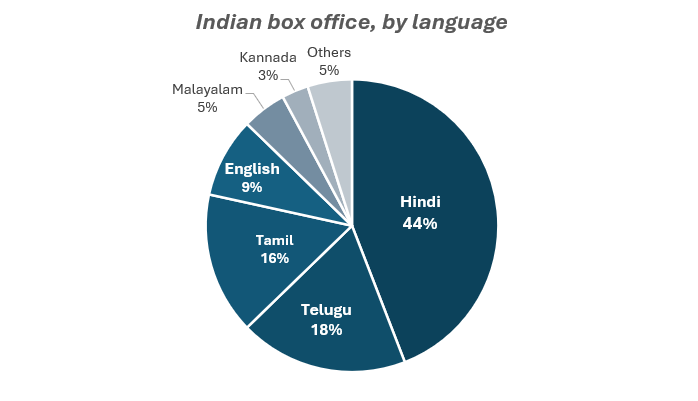
“Bollywood” emerged as a shorthand for Hindi cinema, becoming one of the most recognizable brands associated with the Indian film industry. Widely popularized in the late 20th century as Indian films gained global visibility, the term became firmly established as the industry entered the global entertainment economy. It accounts for almost 44% of viewership and domestic box office revenue.
Following this, other industries adopted similar labels:
- Tollywood (used both for Telugu)
- Kollywood (Tamil cinema, rooted in Kodambakkam, Chennai)
- Mollywood (Malayalam cinema)
- Sandalwood (Kannada cinema)
- Pollywood (Punjabi cinema)
- Ollywood (Odia cinema)
- Bhojiwood (Bhojpuri) among many others
These names were more than linguistic quirks. They represented recognition. To be called a “-wood” was to be seen as part of global cinema discourse. However, not all industries adopted the label. Marathi, Bengali, Assamese, and Gujarati cinema, among others, often continued to define themselves through language rather than branding.
And as these industries gained global visibility, the need to adapt stories across languages became increasingly central.
A New Era: The Rise of the Pan-Indian Film
Today, Indian cinema is undergoing another transformation. The boundaries that once defined audiences are dissolving. Films are no longer confined to regional or linguistic markets. Instead, they’re designed to travel.
From Baahubali and RRR (Telugu), to KGF and Kantara (Kannada), to Pushpa and Sairat, Indian cinema is increasingly built for cross-cultural reach.
Streaming platforms, dubbing ecosystems, and global distribution have brought regional cinema to national and international audiences.
What was once fragmented is now interconnected.
A Multiverse, Not a Monolith
And yet, beneath the global spotlight, the roots remain. Indian cinema is still magnanimous because it is many things at once: myth and modernity, regional pride and national identity, intimate stories and spectacular extravaganzas. From Phalke’s silent frames to today’s Pan-Indian spectacles, the journey of Indian cinema is not just telling us how films were made, but how a nation dreamed, in many languages at once.
At TransPerfect Media, this evolution is understood not as fragmentation, but as the natural architecture of contemporary cinema. Today’s Indian films rarely remain within the language or cultural frame in which they’re made. They move across regions, platforms, and audiences that no longer share the same linguistic reference points but increasingly share the same stories.
In that movement, a simple truth becomes visible: meaning doesn’t travel intact on its own. It has to be carried. Shaped. Reimagined for every audience it reaches. We recognize that Indian cinema was never built on one language, one industry, or one identity to begin with. It remains a cinema multiverse beyond Bollywood, drawing its strength from many cultures, many histories, and many storytelling traditions. Its power has always come from its plurality.
This is where TransPerfect Media India operates: within the living movement of a cinema that continues to expand beyond borders while remaining deeply rooted in the identities that shaped it. We work to make sure these different stories reach audiences as they were intended to be experienced, preserving their authenticity while making them accessible across languages.
Contact our team to learn more.